
Archaeology Policies or Seeking Evidence in the Past to Address Contemporary Issues
Sun, Apr 26
|Sultanbeyli
Time & Location
Apr 26, 2026, 2:00 PM – 4:00 PM
Sultanbeyli, Hasanpaşa, Fatih Blv. No: 33, 34920 Sultanbeyli/Istanbul, Türkiye
About The Event
Curated by Merve Elveren and Meriç Öner, PresentAbsent Programme continues to be on view at YUNT until August 2026.
The second chapter of the series, “PresentAbsent: Under the Rug”, running until 3 May, offers alternative perspectives on the past and future through the extensive research of artists Metehan Özcan, Mona Mahall, and Aslı Serbest.
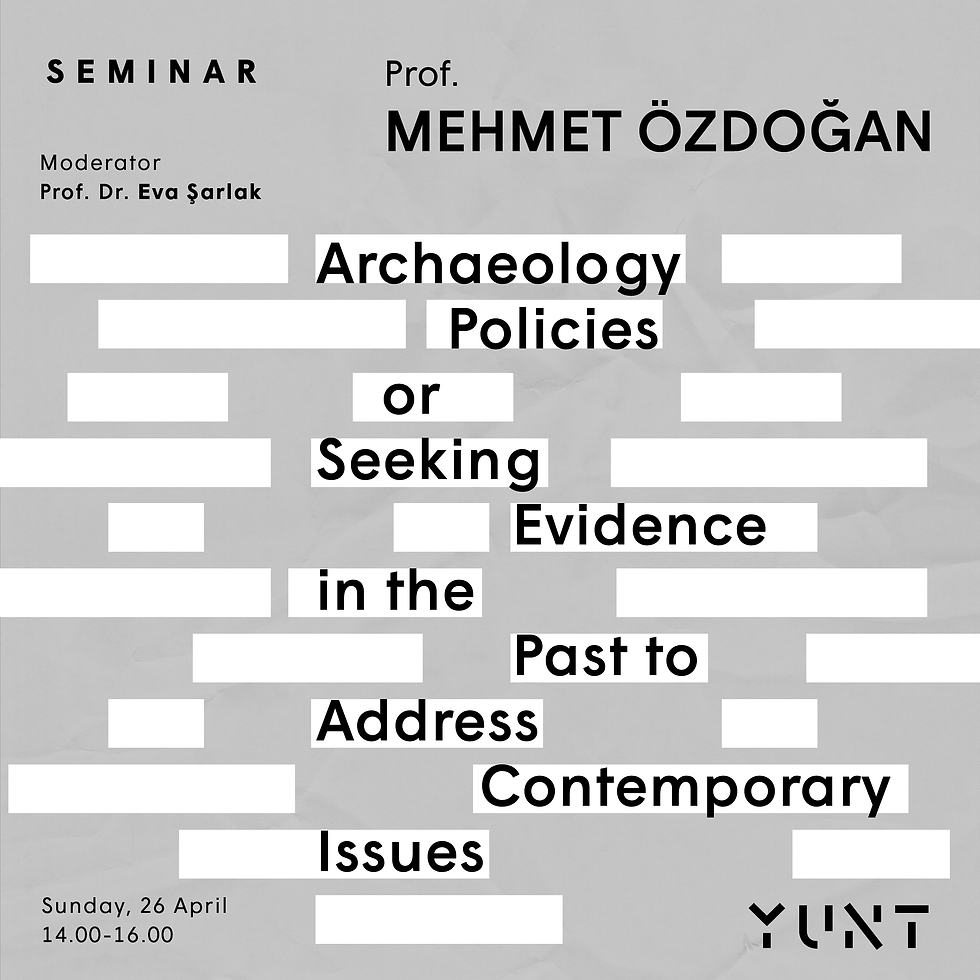
As part of the programme, this talk at YUNT, moderated by Prof. Dr. Eva Şarlak, will feature Prof. Dr. Mehmet Özdoğan, who will emphasise that the past should not be seen as uniform and that archaeology can influence both our present and our future within political and social contexts.
The language of the event is Turkish.
Free Admission
“Archaeology Policies or Seeking Evidence in the Past to Address Contemporary Issues” – Prof. Dr. Mehmet Özdoğan
Seeing the past as a uniform process is a common misconception. In reality, the past -no matter how far back we go- is as colourful as the present; it contains diversity and is constantly in flux. The way the past appears also depends on the questions we ask and what we wish to learn. Conversely, when we suppress the deep temporal dimension of the past and reduce it to a single plane, we see what we want to see and can easily gather evidence that supports our view.
For this reason, archaeology has always served as a political tool, providing evidence to support various beliefs and theories from the nation-building process onwards, shaping not only the present but also the future. Yet, from another perspective, the past has been lived and cannot be altered. The politicised past we seek to see is replaced by the perspective of others, particularly that of science.
In this exhibition, the emphasis on Marija Gimbutas serves as one of the clearest examples of the “politicised past” mentioned above, illustrating how theories explaining the formation of European cultures underwent radical change during the transition from the Council of Europe to the European Union.
Prof. Dr. Mehmet Özdoğan

Born in Istanbul in 1943, Prof. Dr. Özdoğan pursued his academic career in the Department of Prehistory at Istanbul University. His main area of expertise is the “Neolithic” period, focusing on the emergence of village life based on agriculture and animal husbandry and its spread to other regions. Since 1964, he has conducted 25 excavations and surface surveys across various sites in Turkiye, including Çayönü, Yarımburgaz, and Aşağı Pınar, and he currently continues projects on Open-Air Museums and Cultural Heritage in Eastern Thrace.
His other interests include the history of archaeology, archaeological policies, and environmental archaeology. Özdoğan has been a member of prestigious institutions such as the Turkish Academy of Sciences (TÜBA) as a full member (resigned in 2011), the United States National Academy of Sciences (NAS) as a foreign associate, the Archaeological Institute of America (AIA), the German Archaeological Institutes (DAI), Academia Europaea, the Shanghai Archaeology Forum (2017–), the European Research Council (ERC) panel (2013–2022), and the International Prehistory Academy (AIPP, founding member, 2022–).
Among his awards are the TÜBA Service Award (2001), the Vehbi Koç Foundation Award (2008), the Italian State “Cavaliere” Honour, the Chamber of Architects 2020 Award, and the Çukurova Art Initiative 2022 Award. He has also been invited to deliver major lectures, including as Cambridge McDonalds Lecturer (2003) and as a “Cultural Leader” at the DAVOS World Economic Forum (2016).
He has published 27 books and 368 scholarly articles in the fields of archaeology and cultural heritage.